How Important is Adaptation?
The greenest building is one that is already built.
- Carl Elefante
Adaptively reusing an existing building instead of razing and then building something completely new saves a tremendous amount of embodied and operational energy, embodied carbon, and material resources. The HOK adaptive reuse of the historic Moss Courthouse in Salt Lake City demonstrated 50% energy savings, 30% less water usage, 59% reduction in embodied carbon, and $6 million annual savings in lease costs[1] by renovating the existing building as opposed to building a new replacement building. In an extreme example, Cai et al (2015)[2] found that buildings in China only last on average 23.2 years before demolition. The study went on to calculate that if China could extend the average building lifespan from just 23.2 to 50-years, then each year China could save a quantity of energy, carbon and material resources equivalent to the entire environmental footprint of Belgium, Mexico, and Italy combined. Mora (2005)[3] estimates that extending the lifespan of a building from 50-years to 500-years reduces the overall environmental impact by a factor of ten.
Without question adaptation in buildings, breathing new life into old buildings, is a critical piece of solving the sustainability puzzle. In fact, extending the life of buildings is potentially the single most impactful sustainability strategy we have in the building industry[4]. Kohler (2008)[5] even argues that developed countries should never build new and instead only focus on improving what already exists.
Identifying the average lifespan of buildings is challenging because it varies significantly by region and building type and many jurisdictions do not keep track of data such as building age. According to a recent study of almost fifteen thousand demolished buildings in the US and Europe by Berglund-Brown (2025)[6] the vast majority of demolished buildings were in average to excellent condition. In other words, buildings are not typically torn down because of issues related to service life and durability. Instead, building demolition relates to obsolescence (Figure 1) – being old-fashioned or out of date. According to Haapio (2008)[7], a building is obsolete if it does not meet current requirements or expectations. But we need to take a hard look at what those current requirements and expectations are.
Information on addressing design for adaptation is limited, but can be found in some documents such as the AIA document Buildings That Last: Design for Adaptability, Deconstruction, and Reuse[8]. This AIA document includes recommendations such as the inclusion of clear spans, flat floors, a stronger structural system, durable materials, and the use of mechanical fasteners. I would argue that daylighting and universal proportions are also critical elements of design for adaptation.
Every Building is potentially immortal but very few last half the life of a human. - Stewart Brand
[1]https://www.hok.com/projects/view/frank-e-moss-u-s-courthouse/
[2] Cai, W., Wan, L., Jiang, Y., Wang, C., & Lin, L. (2015). Short-lived buildings in China: Impacts on water, energy, and carbon emissions. Environmental Science & Technology, 49(24), 13921-13928.
[3] Mora, P. (2005). Life cycle, sustainability and the transcendent quality of building materials. Building and Environment, 42, 1329-1334.
[4] Mequignon, M., Ait Haddou, H., Thellier, F., & Bonhomme, M. (2013). Greenhouse gases and building lifetimes. Building and Environment, 68, 77-86.
[5] Kohler, N., & Hassler, U. (2002). The building stock as a research object. Building Research & Information, 30(4), 226-236.
[6] Berglund-Brown, J., Dobie, I., Hewitt, J., De Wolf, C., & Ochsendorf, J. (2025). Lifetimes of demolished buildings in US and European cities. Buildings and Cities, 6(1), pp. 1099-1116.
[7] Haapio, A., & Viitaniemi, P. (2008). Environmental effect of structural solutions and building materials to a building. Building and Environmental Impact Assessment Review, 28, 587-600.
[8]https://www.aia.org/sites/default/files/2024-11/AIA_Design_Deconstruction_Adaptability_Reuse.pdf
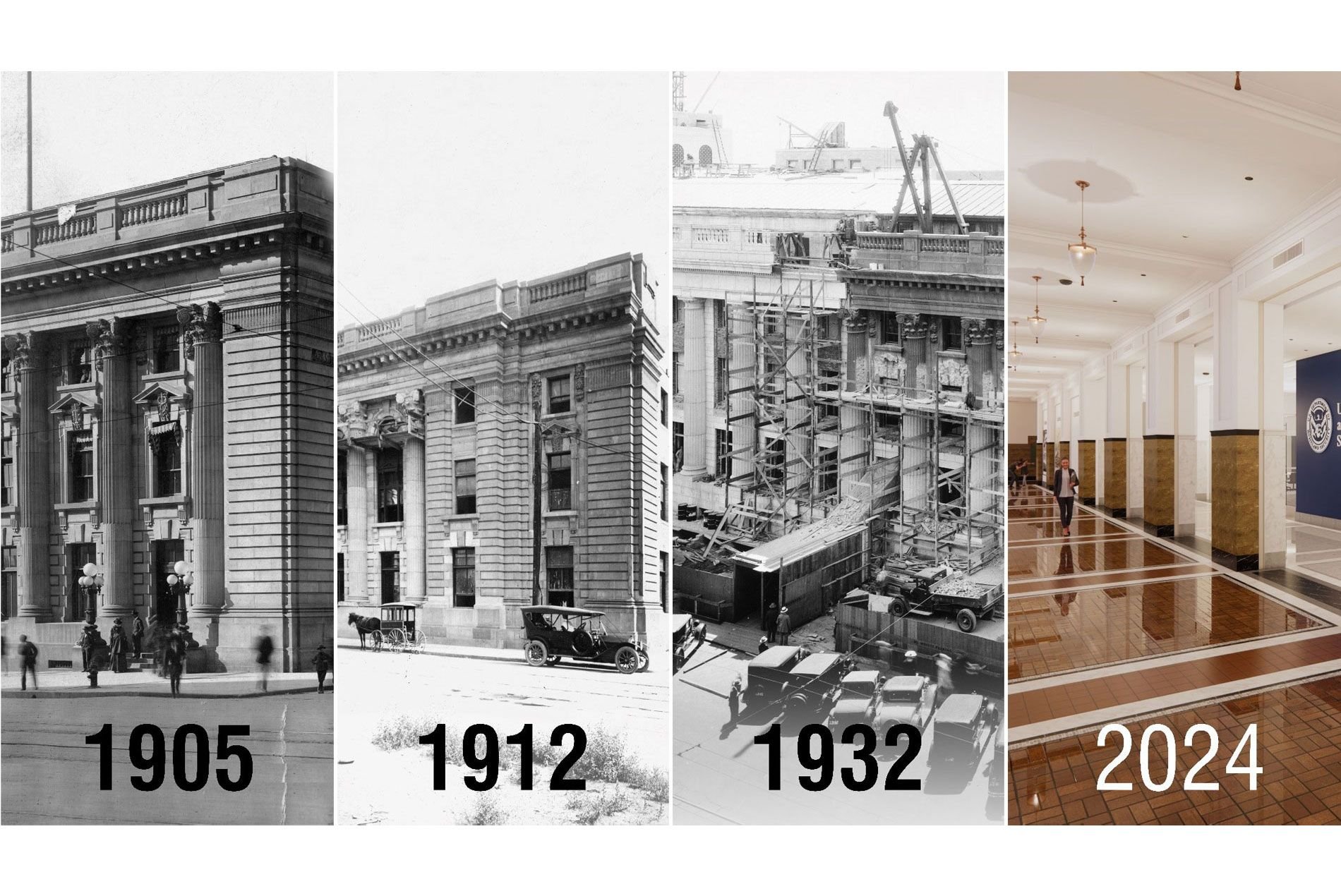
Frank E. Moss U.S. Courthouse in Salt Lake City, Utah by HOK https://www.hok.com/projects/view/frank-e-moss-u-s-courthouse/
